

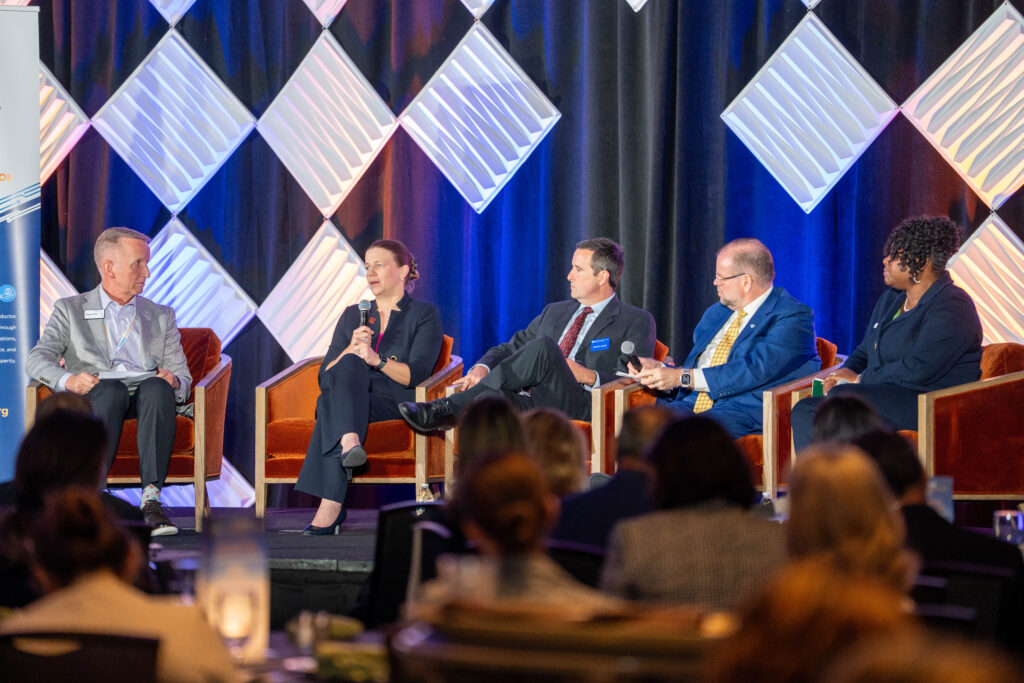
Higher education leaders shared insights on preparing the semiconductor workforce in Florida. Photo: Florida Semiconductor Engine.
KISSIMMEE (Sept. 2, 2025) — Florida leaders from government, industry and higher education say the state is poised to become an international hub for specialized semiconductor innovation as they gathered for the inaugural Florida Semiconductor Engine Conference “Powering Prosperity,” drawing more than 250 participants for the milestone event on Aug. 28.
“This conference is more than a singular event,’’ said Ron Piccolo, interim CEO of the Florida Semiconductor Engine. “It is the continuation of strategic, bold, and coordinated efforts that will shape the future of semiconductor technology in Florida, the U.S., and around the world.”
The National Science Foundation-backed consortium, which is headquartered at Osceola County’s NeoCity technology district, could receive up to $160 million over the next decade to grow the state’s advanced semiconductor packaging industry. Osceola County has received $50.8 million from the U.S. Economic Development Administration in 2022 through the Build Back Better Regional Challenge and the county is set to receive up to $289 million from the Department of Defense for microchip production and related workforce development.
Panel discussions throughout the day focused on workforce needs and education pipelines, but also gathered an array of industry, academic and economic development leaders to build momentum for the semiconductor sector — with an emphasis on advanced packaging which enables specific, complex technologies in contrast to the chips used in everyday items — in Florida. Florida has a significant and growing semiconductor sector that is well-positioned for future growth amid a national effort to reshore semiconductor manufacturing as well as growing demands for the technology as AI, the space industry and a host of other tech-driven sectors accelerate.
Florida ranks third in the U.S. for semiconductor establishments and fifth for semiconductor manufacturing employment with more than 18,000 jobs. On a national level, the focus on returning semiconductor manufacturing to the U.S. is gaining momentum, promising billions of dollars of investment and a half-million new jobs.
“We are in the perfect position, I’d argue, and the best position of any state in the nation to be able to go out and attract those jobs,” said Florida Commerce Deputy Secretary Jason Mahon, noting the state has invested $380 million in semiconductor workforce education over the past four years.
Preparing Florida’s Semiconductor Workforce
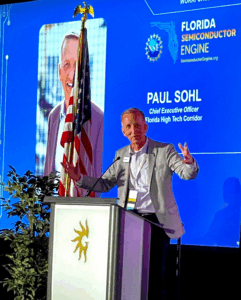
Paul Sohl
Florida High Tech Corridor CEO Paul A. Sohl led a panel discussion on preparing the semiconductor workforce in Florida with University of Central Florida President Alexander N. Cartwright, Valencia College President Kathleen Plinske, University of South Florida Vice President for Research & Innovation Sylvia Wilson Thomas, PhD and Florida Semiconductor Institute Director David Arnold of the University of Florida. All four institutions are part of the NSF Engine coalition.
The panel highlighted Florida’s drive to develop the talent pipeline to grow and sustain the high-tech workforce includes producing researchers and innovators, but also the technical talent that drives the production industry requires.
Just the day before the conference, Valencia College unveiled Florida’s first associate in science degree in Semiconductor Engineering Technology. Launched in partnership with the Florida Semiconductor Engine, the program is designed to train technicians particularly at the NeoCity technology district and was developed with input from SkyWater Technology and other employers. “Give us 15 weeks — and we can help you earn an industry certification that will land you a full-time job with benefits,” Plinske said.
Cartwright said UCF has expanded its engineering enrollment from 12,000 to 17,000 students and aims to reach 50,000 technology majors to meet the talent and skills demand. “UCF was founded as a startup with a mission to provide workforce, and that’s the mindset we need to expand across Florida,” he said.
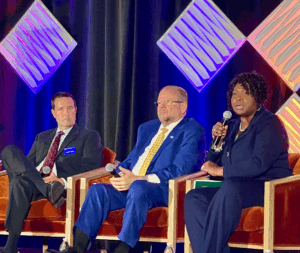
Sylvia Wilson Thomas is an internationally-known expert in microelectronics.
Thomas, a microelectronics expert whose many inventions have earned her a place in the Florida Inventors Hall of Fame, said semiconductors go beyond technology prowess and are a crucial component in addressing some of the world’s great challenges. “When we talk about AI, what is the underlying technology behind it? It’s semiconductors,” she said. “Helping society understand that research in this field directly impacts health, transportation, and communication is critical and commercialization is how we turn that into real impact.”
Arnold said partnerships and collaborations are key to building upon Florida’s foundation in semiconductors, but more needs to be done to move ideas from university labs to market and connect investors and industry to higher education’s innovations. He described one new effort by the Florida Semiconductor Institute, Lab Link, which is sparking new connections between Florida’s universities and also between students and faculty members. “We challenge these teams of students to come up with an idea that came out of (their) conversations,” he said. “Our goal is to try to fund these as collaborative inter-institutional research partnerships.”
Voices from the Conference
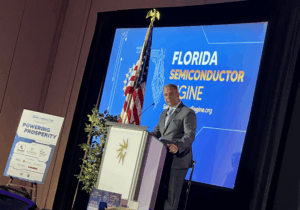
Ron Piccolo, Interim CEO of the Florida Semiconductor Engine: “We have a mission to transform the U.S. semiconductor industry through collaborative research, to build the most advanced technical workforce in the nation and to create regional economic prosperity that has national and global impact. Now, these are not small ambitions. These are rather bold statements — especially when we talk about things like global leadership and industry transformation. If this were to happen, it won’t happen by accident and it won’t happen by good luck. It will only happen by visionary leadership.”
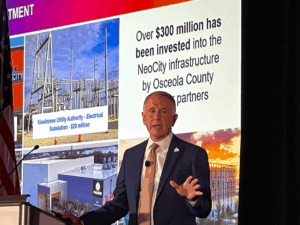
Don Fisher, Osceola County Manager and leading figure in the development of NeoCity, a 500-acre technology district in Kissimmee: “We have been in this development process since 2014. … It’s just a long haul to keep rolling it forward to get those businesses and get that cluster going. ..Something is going is right. In the past 36 months we have received over $500 million in investment, either from the State of Florida or our federal partners.
“Osceola County and its partners were one of three clusters in the United States that received both Build Back Better and National Science Foundation awards. So, if you are wondering if you did something well — you want to be affirmed that the decision you made back in 2014 were the right ones — the federal government is telling us you did the right thing, continue to work on it.”
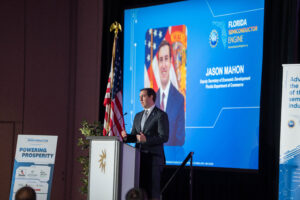
Jason Mahon, Deputy Secretary of Economic Development for Florida Department of Commerce: “About four years ago, we recognized making investments in growing the semiconductor industry in Florida. We recognize it would be really important from both a national security perspective and a lot of opportunity for the state.
“At the state level, we’ve invested $380 million into the workforce education side and we did that because we believe, fundamentally, that’s where we need to have our investments if we are going to have these opportunities and we are going to grow. … Obviously, you build facilities and you invest in infrastructure, but if you don’t have people who are going to work in them, we’re not actually going to go anywhere.”