

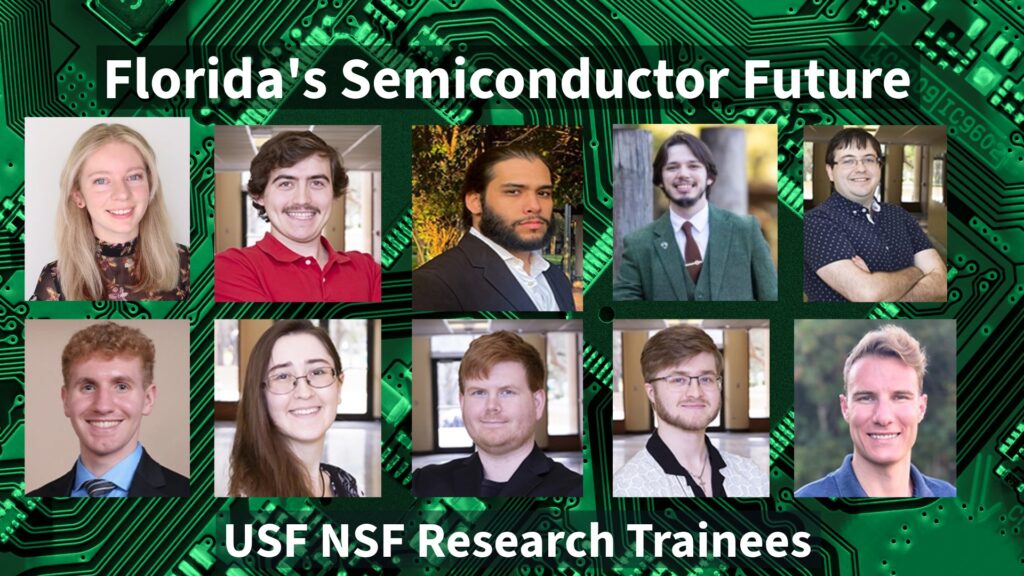
The USF-NRT Trainees are: (Top, left to right): Anne Evans, Kaleb Sharrer, Samir Ahmed, Logan DiFiore and John Maurer. (Bottom, left to right): Brian Murray, Isabelle Eskanos, Justin Mcmillen, Peter Kveton and Sean Knapp.
TAMPA — For decades, Florida has been quietly building one of the most significant centers of semiconductor and microelectronics in the nation and has become home to scores of companies, thousands of high-wage jobs and billions of dollars in economic activity, backed by strategic investments in the sector’s workforce and infrastructure.
The future of this fast-moving industry will depend on building a world-class talent pipeline, which is why the Florida High Tech Corridor and the University of South Florida launched a partnership to train a new generation of highly skilled graduate students in semiconductor and microelectronics technology, strengthening Florida’s role in a critical industry tied to both economic growth and national security.
The collaboration supports graduate students participating in the National Science Foundation’s National Research Traineeship (NRT) program at USF, which focuses on semiconductor design, manufacturing, and packaging. Florida leaders have emphasized the importance of rebuilding domestic semiconductor capacity, and the program is designed to ensure the industry has the advanced talent needed for long-term success.
“The future of the semiconductor industry depends on people as much as technology,” said Corridor CEO Paul Sohl. “By investing in the training of the next generation of leaders, we’re ensuring Florida has the talent needed to drive innovation, strengthen our economy, and compete globally in this vital sector for decades to come.”
Through the partnership, The Corridor is providing supplemental financial support to NRT trainees who are not eligible for external fellowships. The Corridor’s investment builds on a five-year, $3 million NSF grant awarded to USF in 2024 to develop a comprehensive, experiential education and research program in next-generation microelectronics. The program is led by USF College of Engineering Professor Ashok Kumar and a multidisciplinary team of faculty and staff with expertise spanning an array of engineering fields as well as innovation and entrepreneurism.
A “much-publicized semiconductor chips shortage has impacted several critical industries. A skilled and diverse pipeline of workers is critical to building a sustainable domestic semiconductor industry and to achieving the CHIPS Act economic and national security goals,” said Kumar, the principal investigator of the NSF NRT. “This NRT grant will provide to better prepare master’s and doctoral students for the interdisciplinary talents required in semiconductor chip development.”
Graduate trainees receive extensive support, including an annual $34,000 stipend from the NSF NRT program, paid tuition and fees, and an additional $34,000 stipend through the Florida High Tech Corridor at USF. Beyond financial support, students gain hands-on research experience and interdisciplinary training in semiconductor technology, along with professional development in entrepreneurship, leadership, communication, and project management.
The program also offers opportunities to earn a Semiconductors & Microelectronics Technology Certificate, participate in summer internships, and pursue international research experiences, preparing graduates for leadership roles in the global semiconductor industry. An industry and academia advisory board that includes both national and international leaders is helping shape the programs.
The program also actively engages with the Florida Semiconductor Institute and aligns with the Florida Semiconductor Engine based in NeoCity in Osceola County.
Meet some of the USF NRT trainees and learn about their work in this video from the USF College of Engineering.
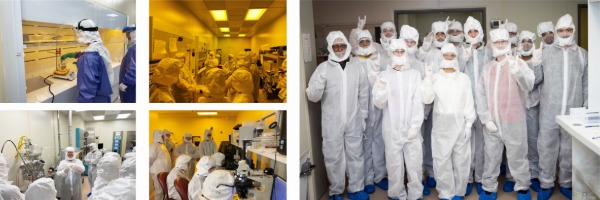
USF NRT Trainees in the clean room at USF’s Nanotechnology Research and Education Center as they expand their expertise in semiconductor manufacturing and advanced packaging. The facility is equipped with state-of-the-art semiconductor manufacturing tools and serves as the primary location for the labs, allowing students to engage directly with the advanced technologies used in the microelectronics industry. (Photo courtesy of USF NRT Research Training Program.)